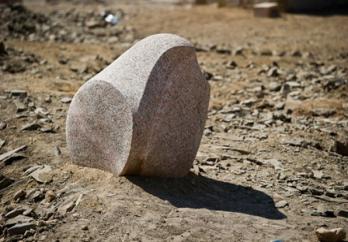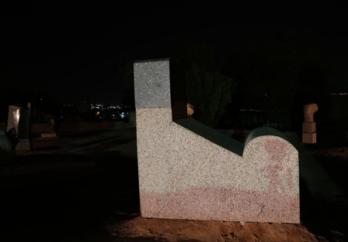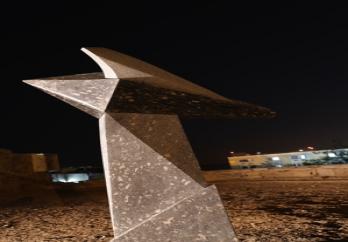
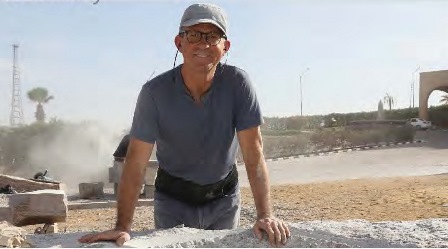
The German sculptor Tobel describes the experience of participating in the Aswan Symposium for Granite Sculpture as inspiring, and he says: "Working contemporarily in stone, against the background of the civilization of ancient Egypt, is a unique experience of its kind."
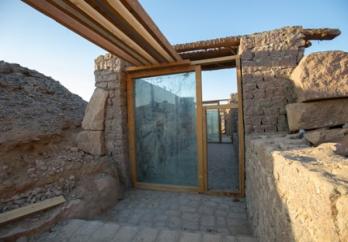
Tobel points to his previous experiences, during which he presented more than 60international projects, whether within the framework of competitions or sculpturesymposiums,citing his monumental sculptural works that are present in 25 countries across five continents. However, working in the Aswan Symposium remains a different case, deriving its uniqueness from the artists' proximity to the ancient granite quarries, from which the ancient Egyptians extracted the stones with which they built their Pharaonic civilization, and from which theyformed statues that still stand to adorn temples and museums. Working with the same material gives the artist a special feeling while carrying out his work.
He views stone as a permanent material that does not perish, and according to his vision, this is what makes us able today to contemplate the sculptural works produced by the civilization of ancient Egypt. Through his participation in the symposium, he presents a contemporary sculpture bearing his signature, to join this extended timeline of the history of the art of sculpture.
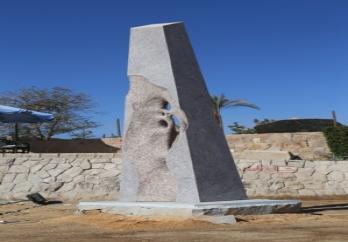
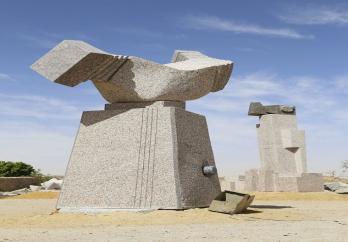
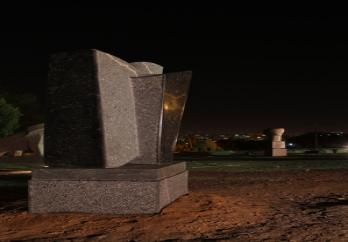
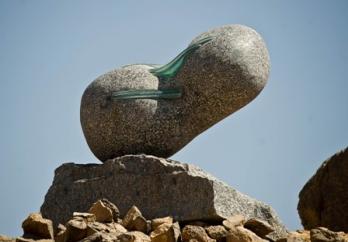
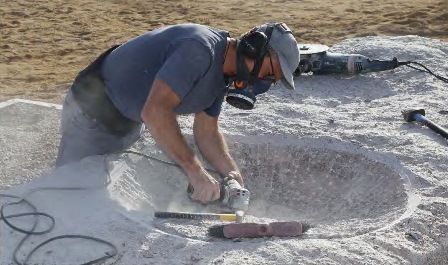
In his work titled "Transformation," Tobel attemptsto go beyond many of the well-known rules in the art of sculpture, and according to his statement, he proceeds in his work contrary to the traditional method of dealing with stone. The artistic intervention is limited to carving inside the stone mass only, through which he transformed its core into an abstract drawing reduced to the void in a spiral form, leaving the external surfaces preserving the outer nature of the stone, in order to realize concepts that express his own trilogy: "Raw, Strange, Eternal."
 |